Snohomish County Police Agencies Remain Far Whiter Than the Communities They Serve, Analysis Finds
Records from nearly every police agency in the county show officers and staff are disproportionately white, and departments say they are working to recruit a more representative workforce.
By Jennifer Paige ·
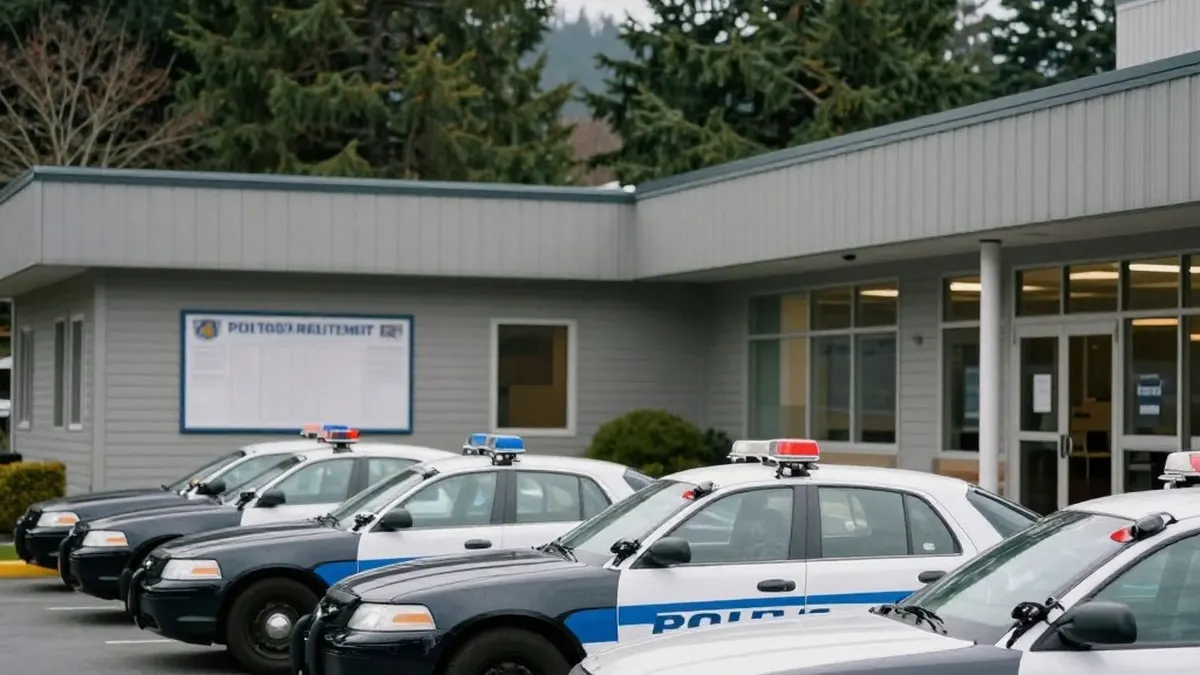
Most police departments in Snohomish County employ a workforce that is disproportionately white, even as the communities they serve grow more diverse, according to an analysis of public records by The Daily Herald. Law enforcement leaders acknowledge the gap and say closing it has become a priority in their recruiting.
The newspaper requested demographic data from every agency based in the county except Bothell, which spans both King and Snohomish counties. Most figures were current as of Jan. 1 and covered civilian employees as well as sworn officers. In Mountlake Terrace, 35 of 38 department employees reported being white, while the city is under 70% white by Census estimates. In Everett, more than 82% of the department was white, underrepresenting Black, Asian, Latinx and multiracial residents. Only Marysville and Edmonds had police workforces roughly as diverse as their cities, or more so.
Alexes Harris, a University of Washington sociology professor who studies racial inequality in the criminal justice system, reviewed the data and described a "great deal of racial under-representation." Across all agencies combined, only about 2% of officers were Black, and fewer still were Native American. Harris said better dialogue, respect and trust between historically marginalized communities and police are needed, because without those connections people cannot be expected to want to work for the agencies.
Paul Benz, co-chair of the criminal justice committee for the NAACP Snohomish County, said the findings did not surprise him. Staffing across many systems lags behind changing communities, he said. "We want a law enforcement system that looks like the community they serve," Benz said. "It's not just the face. It goes deeper than that. But you have to at least start there."
Outside the sheriff's office, the county's largest agency, departments reported just 15 Black employees in total. The sheriff's office said 0.5% of its employees were Black, compared with 3.8% of county residents, though its exact service area is unclear because it covers only unincorporated areas and small cities without their own police. The race of more than a quarter of sheriff's employees was listed as unknown, and Lake Stevens reported all 38 of its employees as being of unknown racial background. Arlington reported an all-white workforce. Chief Jonathan Ventura said his department has historically been far more diverse than the community, which is over 81% white, and attributed the current numbers to recent departures of several officers. Arlington offers a $5,000 incentive to new officers proficient in Spanish or American Sign Language.
Everett Police Chief Dan Templeman said recruitment of people of color has intensified in recent years, including assigning an officer to recruiting full time. Nearly half of the 15 officers hired this year are people of color, he said, but recruitment is harder than at any point in his three decades in policing. Everett has added six background investigators to process a shrinking pool of applicants, and it recently received a $60,000 state grant to recruit and train women and candidates from underrepresented groups. The money will pay for a recruitment video, help cover entry-level testing costs that can burden low-income applicants, and fund visits to historically Black colleges and universities. The grant follows a state law, passed unanimously by both legislative chambers and signed last year, meant to encourage a broader diversity of candidates.
In Marysville, Cmdr. Adam Vermeulen said the department has advertised on pop and talk radio and held recruiting forums. A school district employee recently advised him that the department should be clearer about its education requirements. "Let people know that all we require is a high school diploma, so we can get more candidates in there," he said. Of Marysville's 103 employees, one is Latinx and none are Native American, while about one in eight residents is Hispanic or Latinx.
Lynnwood police Sgt. Joe Dickinson, who has helped hire more than a half-dozen officers since June 2021, described a process designed to limit bias. Candidate profiles passed to him omit age, race and sex, and only the top 20 test scores reach him. Finalists undergo a third-party polygraph and an interview with command staff, including a member of the department's race and equity committee. Dickinson said a more representative department can build public trust, pointing to a recent crash where an officer's use of Indonesian helped officers understand what happened. More than 38% of Lynnwood residents speak a language other than English at home.
Templeman called diversifying a police force "a work in progress" that requires commitment from mayors, elected officials and the department itself, and said it cannot happen overnight.
Source: The Everett Herald